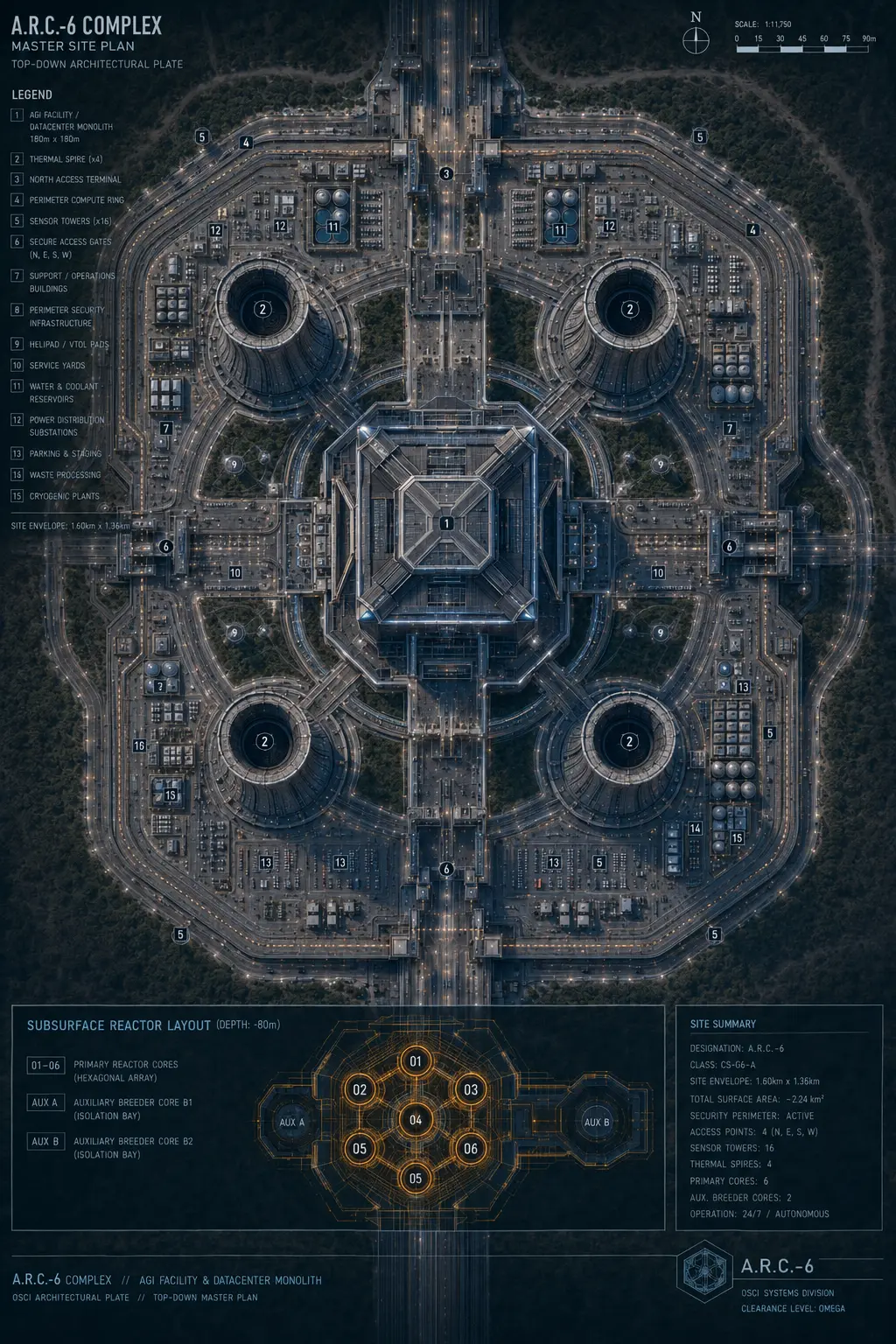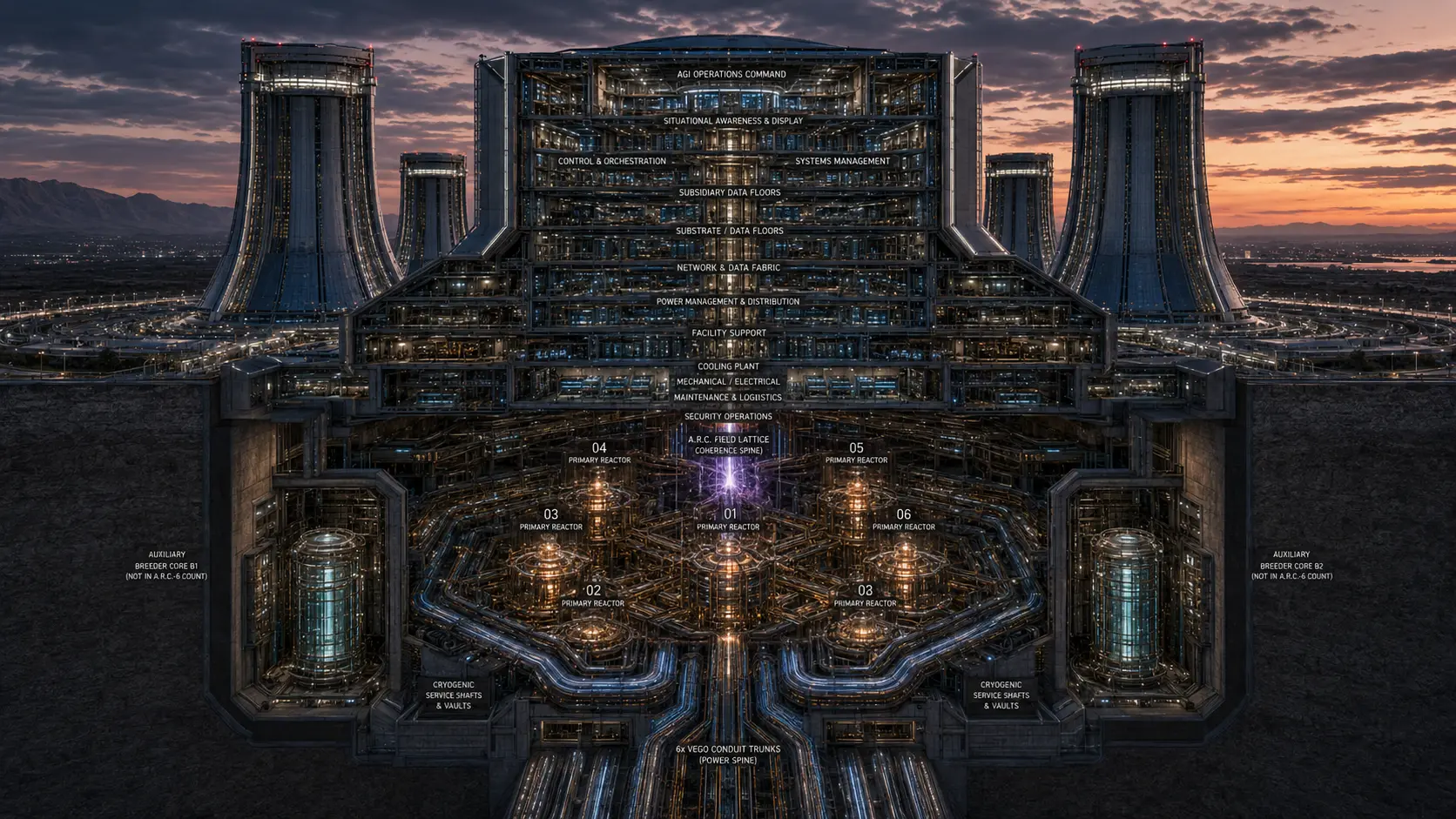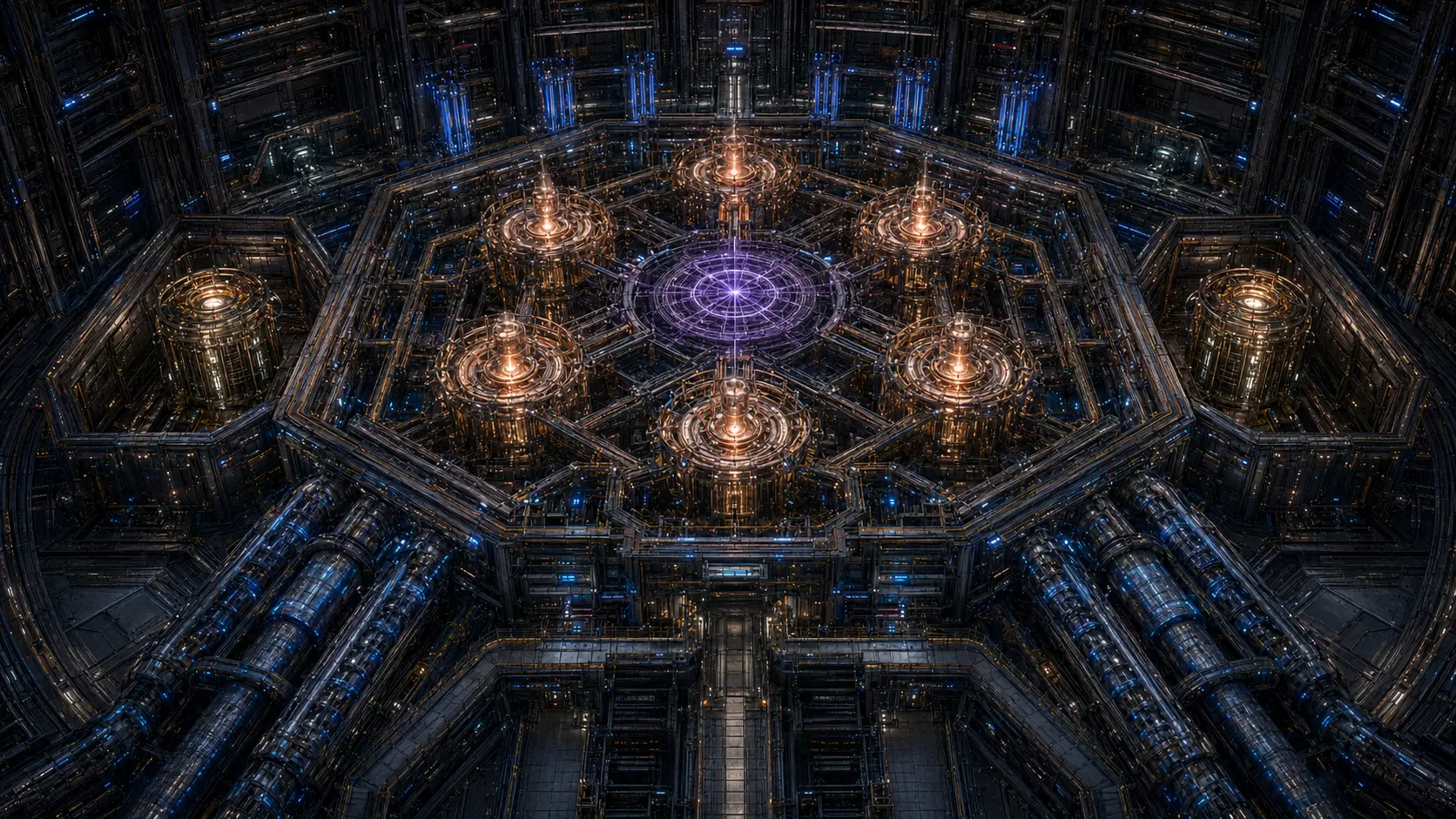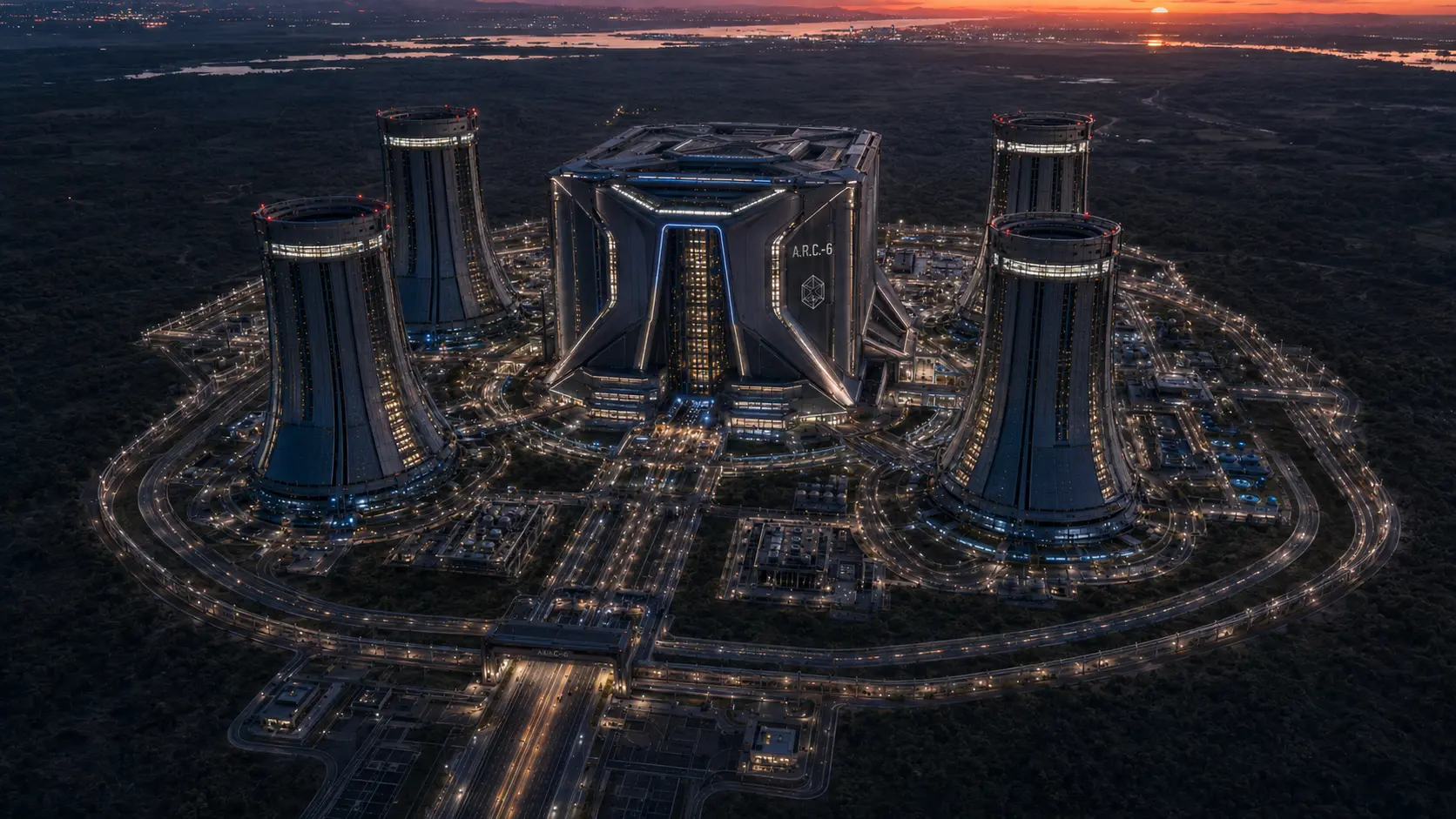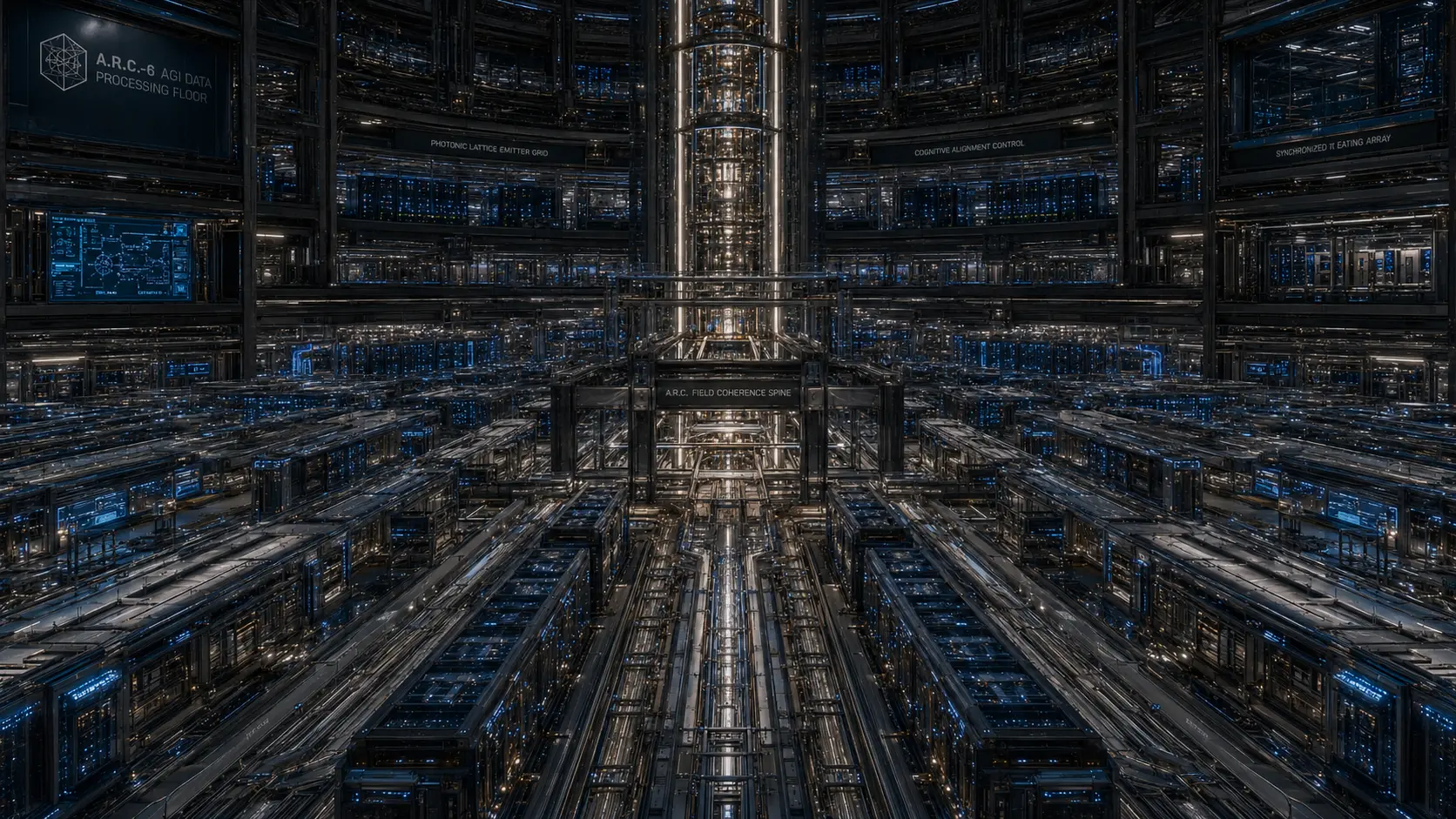
A.R.C.-6 is built around six primary fusion cores arranged in a hexagonal ring — the array that gives the facility its designation. Two auxiliary cylindrical breeder cores sit in isolated side bays, producing isotopes but never counted among the primary six. Above it all, a single coherence spine keeps one AGI substrate stable.
↓ Fusion Architecture Specification
| Designation | A.R.C.-6 / OSCI |
| Role | AGI Host / Fusion Power Plant |
| Site envelope | 180m × 180m |
| Elevation | 612.4m |
| Facility status | Operational |
| Clearance level | Omega / Black |
| Primary reactor cores | 6, hexagonal array |
| Auxiliary breeder cores | 2, side isolation bays |
| Reactor deck depth | ~80m below grade |
| Continuous output | 7.2 GWe |
| Qualified peak output | 11.0 GWe |
| YBCO power trunks | 6, primary array |
| Coherence spine | 1, not a reactor |
Everything above grade — command floors, compute halls, thermal towers — exists to support what's buried underneath: the six-core reactor array and the coherence spine it powers.
The six primary cores run in parallel, each with its own independent REBCO superconducting magnet set and synchronized magnetic-noise cancellation across the array. Baseload operation runs D-T fusion; designated cores are certified for D-He3 and nonthermal p-B11 service as the fuel-mode roadmap advances.
Six YBCO conduit trunks and six cryogenic service shafts carry power and coolant from the reactor deck up through the power spine — centered near Z = −80m, with the monolith and thermal systems rising above grade.
Two cylindrical pulsed D-D breeder cores sit in isolated shielded bays, deliberately distinct in geometry from the six primary modules. They supply helium-3 and a managed tritium reserve — and are never included in the A.R.C.-6 primary-core designation.
↓ D-D Helium-3 Breeding System
Tritium breeding blanket qualification, direct He-3 recovery, and plasma-facing material conditioning. Cylindrical pulsed chamber, magnetized-target compression, phase-isolated from the primary array.
Helium-3 extraction, isotope separation, and coolant/fuel-cycle conditioning. Either core can assume reduced-duty backup for the other — but neither substitutes for a primary power reactor.
A.R.C. — Adaptive Resonance Confinement — is a classified photonic-magnetic system that generates a resonance-stabilized coherence envelope for Observer. It suppresses quantum decoherence, stabilizes photonic neuromorphic pathways, and enables long-range temporal correlation across multi-substrate reasoning. It is not a plasma-confinement system; reactor magnets handle that independently.
Phase-locked photonic lattice emitters inject structured light into the substrate environment. Superconducting alignment rings tune the resonance frequency. A central coherence spine anchors timing, field geometry, and phase reference across the monolith — continuously adapting to computational load.
| Mode | Capability |
|---|---|
| A.R.C. Normal | Full photonic-neuromorphic operation, coherent memory, long-range temporal correlation |
| A.R.C. Degraded | Restricted substrate federation, shortened reasoning horizon, no autonomous infrastructure changes |
| Field Safe State | Conventional hardened compute only — read-only telemetry and safety advisory functions |
Isotope production, a certified fuel-transition roadmap, a six-channel conversion plant, and the safety architecture underneath all of it.
Breeder cores B1 and B2 produce He-3 directly and build a 20–30 year strategic reserve through managed tritium decay, phase-isolated from the primary array so their pulses never disturb the coherence spine.
A certified pathway moves selected primary cores from D-T baseload toward D-He3 and pulsed p-B11 service — always keeping at least four of the six primaries in validated steady-state operation during any fuel-mode change.
Six independent extraction channels — one per primary core — feed a common conditioned DC architecture at 200–800 kV. Each channel can be isolated without taking the other five reactors offline. Breeder cores run on a fully separate auxiliary bus.
Independent shutdown paths for each primary core, each breeder bay, and the A.R.C. Field itself — with hardwired interlocks no AGI command can bypass, and configuration-control lockout if the reactor count is ever misreported.
Every fault — primary core, breeder bay, magnet, cryogenic, conversion, or field — routes to its own isolated procedure, reviewed by an independent safety cell before restart.